

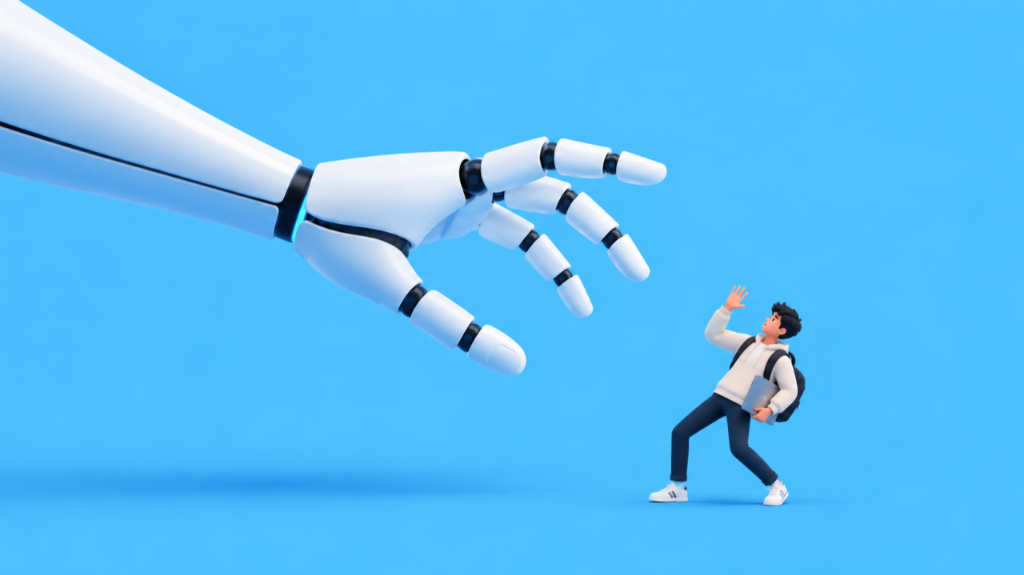
Nobody got fired. That's the strange part here.
There was no dramatic memo, no boxes carried out of the office, and no news crews outside. Yet a whole generation of 22-year-olds is refreshing their inboxes, waiting for a reply that isn't coming.
This isn't a story about AI taking your boss's job. It's about the first rung of the ladder quietly disappearing.
The Crime Scene with No Body
Stanford Digital Economy Lab economists studied payroll records covering millions of American workers. Entry-level hiring in AI-exposed jobs, such as customer service, accounting, and software development, fell 13 percent relative to less-exposed jobs like nursing. Depending on the version of the study, you'll see 13% or 16%. The direction is the same either way.
The software developer numbers are sharper. Employment for developers aged 22 to 25 had fallen nearly 20% from its late-2022 peak by September 2025. Meanwhile, older workers in the most exposed occupations saw a 6-9% increase.
Same jobs, same companies, opposite outcomes, and the only difference is age.
Nobody is being pushed out, either. The researchers say the drop comes mainly from weaker hiring, not from layoffs or people quitting. The jobs aren't being taken away. They're just not being posted.
And in the 60% of occupations least touched by AI, young workers' employment actually grew 10%.
This isn't "Young people can't find work." It's "Young people can't find this kind of work."
Why the Juniors?
Think about what a fresh graduate brings on day one: what they learned in school. That is exactly the kind of knowledge AI now reproduces. Stanford's team found that jobs resting on tacit knowledge, the kind you only pick up by doing, showed stronger growth for mid-career and senior workers.
In short, AI has read every textbook ever written and never survived a single awkward Monday meeting. It can write a flawless project plan. It can't tell your boss, gently, that the project is doomed.
So experienced people, who carry judgment, context, and scar tissue, are fine. Beginners are being asked to compete with a machine on the one thing beginners had.
The Numbers Outside the Lab
The New York Fed tracks recent college graduates aged 22 to 27. Their unemployment hit 5.6% in March 2026, against 4.3% for the overall workforce. That's a reversal. In March 2019 the grad rate was about 3.6%.
A degree used to be the safety net. Right now it's more of a safety hammock.
AI isn't the only suspect, but it's the one with the strongest alibi problem.
Meanwhile, in India
India produces roughly 1.5 million engineering graduates a year, and IT accounts for over half of fresher hiring. So the shift shows up here quickly:
- TCS says 60% of its FY26 fresher hires were AI-skilled, up from 10–15% three years ago. It’s also reported to be cutting its FY27 fresher intake to about 25,000 from 44,000.
- Infosys hired 11,900 freshers in FY24, a 76% drop from over 50,000 in FY23.
- Wipro reported onboarding no fresh graduates in April-June 2026 and has set no fresher target for the year.
Some of these come from secondary reports, so check the company filings before quoting them. Still, the pattern is consistent: fewer seats, and a higher bar to sit in them.
The Part Nobody's Budgeting For
Here's the plot twist the cost-cutters are missing. One founder is hiring mid-level strategists instead of entry-level staff, but mid-level people come from entry-level jobs.
Entry-level roles are the economy’s training system. That’s where young engineers learn how production systems break, and where analysts learn what a bad spreadsheet smells like. Skip that stage and you save money this year. You also stop manufacturing the experienced people you’ll badly need in the 2030s.
Anthropic’s CEO warned in 2025 that AI could wipe out half of entry-level white-collar jobs within five years. Maybe he’s right, maybe not. But companies that make that bet are quietly burning the seed corn.
So What Do You Do?
The honest answer isn't “avoid AI.” The realistic competition is a colleague using AI, not a machine alone, and the path is fluency with the tools plus domain judgment and people skills. Some practical moves:
- Ship real things. A portfolio of working projects proves the tacit knowledge a degree can’t.
- Be the person who checks the AI. Anyone can generate output. Few can tell when it’s wrong.
- Look at small companies. Mark Cuban’s advice for young workers is startups and small firms. They still need someone who does a bit of everything.
One More Thing
AI didn't fire an entire generation. It did something subtler: it made the front door cost more.
The good news is that doors can be rebuilt, and the people who learn to walk through this one will be rare. The industry's quiet bet is that it can have senior talent without ever training juniors. That bet won't age well.